E-Commerce Enabler vs Distributor vs In-House: Which Operating Model Fits Your Brand?
An e-commerce enabler operates your marketplace business while you keep control of pricing and brand. A distributor buys your stock outright and resells it on its own terms. An in-house team gives you full control at full fixed cost. The right choice depends on your order volume, your entity status, and your existing distributor obligations.
Most brands do not choose an operating model. They fall into one, usually because someone was available: a distributor already selling offline offers to take the online business, or a marketing coordinator gets handed Shopee “for now.”
Both are survivable at low volume. Neither survives contact with a serious campaign calendar.
This is the comparison of the three real options, what each one is genuinely good and bad at, and the point at which staying put starts costing you more than switching.
Running your marketplace business in-house
How does this work? You hire the team, you own the seller accounts, you run the ads, you handle the customer service, you file the returns.
Pros
You keep full control of price, brand, and data. Nobody discounts your hero SKU to hit their own quarterly number. You see every search term, every conversion rate, and every customer.
No partner take rate. Whatever survives platform fees is yours. At high volume this is the largest single argument for in-house and it is a good one.
You build capability you keep. A team that has run four peak seasons is an asset that stays on your org chart. Partner knowledge walks out the door when the contract ends.
Cons
The fixed cost lands before the revenue does. Headcount, content production, listing tools, ad management, and customer service all have to exist before your first campaign, not after it.
Competence takes time. Platform mechanics, campaign submission windows, ad bidding behaviour, and live commerce production are learned by doing them badly first. That learning happens on your GMV.
You carry the compliance load alone. Invoicing under BIR rules, reconciling withheld taxes against platform statements, and handling account suspensions and listing takedowns are all yours. These are unglamorous and they are where small teams quietly lose money.
When does in-house make sense?
When you have the management bandwidth to actually supervise it, when your category needs constant merchandising judgment that a partner cannot make for you, and when you are at enough volume that the fixed cost divides down to something reasonable per order. In-house is not the cheap option. It is the option that becomes cheap at scale.
Selling through a distributor
The distributor buys your inventory at a discount and resells it online under its own seller account. Legally, they are the seller.
Pros
Inventory leaves your books on sale. You invoice the distributor, you get paid, and the working capital problem becomes theirs. For a brand managing cash tightly, this is not a small thing.
Operational burden drops to near zero. No accounts to manage, no ads to run, no customer service queue, no campaign deadlines.
They fund the market. Distributors typically carry their own marketing spend, their own warehousing, and their own team.
Cons
You lose price control, and online price erosion is contagious. A distributor optimising for volume will discount to move stock. Marketplace prices are public, so that discount becomes your visible price everywhere, including to your offline trade partners. This is the single most common source of channel conflict we see.
You go data blind. You do not see who bought, what they searched for, which listing converted, or why a campaign underperformed. You get a purchase order and a guess.
Incentives diverge structurally. A distributor earns on the spread between buy price and sell price. That rewards discount depth and volume velocity. It does not reward brand equity, content quality, or long-term price integrity. Neither party is behaving badly here. The contract simply pays for different things than you want.
When does a distributor make sense?
When you want out of operations entirely and can genuinely accept the loss of price control, or when the distributor relationship predates your online ambitions and renegotiating it costs more than it gains. It also works when online is a small fraction of your business and you would rather protect the offline relationship than optimise the digital one.
Working with an e-commerce enabler
An enabler operates the business on your behalf. Depending on the structure, they may also act as Seller of Record, which means they hold the account, issue the invoice, and carry the tax obligations while you keep commercial control.
Pros
Speed. Existing platform relationships, account standing, and campaign slot access mean you launch in weeks rather than quarters. Platform programs like Shopee Mall and LazMall have requirements that take time to satisfy from a standing start.
Capability breadth without headcount. Advertising, content, live selling, customer service, fulfilment coordination, and compliance under one contract. Hiring those roles individually is both expensive and slow, and most brands do not need any of them full time at the start.
Price and brand control stay yours, contractually. This is the structural difference from distribution. In an enabler arrangement the pricing policy is written into the agreement rather than surrendered with the stock.
Cons
Partner dependency is real. Account ownership, historical performance data, and accumulated review history are all things you can lose in a bad exit. Negotiate the offboarding terms at signing, not at termination.
Quality varies widely. Barriers to entry in this category are low. Plenty of operators can list products. Far fewer can run a profitable live selling schedule, diagnose an ad account, or reconcile a platform tax statement.
You are paying for it. Whatever the structure, an enabler compresses margin relative to a mature in-house team. The question is whether your in-house team is mature, and what the gap costs you in the meantime.
When does an e-commerce enabler make sense?
When you need capability faster than you can hire it, when your campaign calendar has outgrown your team, or when you need a Seller of Record because you have no Philippine entity. It also makes sense as a deliberately temporary arrangement: run through a partner while you build in-house, then transition. That is a legitimate plan, and any enabler worth hiring will write it into the contract.
At what order volume should you change models?
These bands are indicative. They shift with average order value, SKU count, and how much customer service your category generates. A 40-SKU electronics catalogue and a 400-SKU apparel catalogue break at very different points. Use them as a prompt to look, not as a rule.
| Monthly orders | What breaks | What to do |
|---|---|---|
| Under ~300 | Nothing yet | A founder or one generalist can run this. A partner is overhead at this stage |
| ~300 to 1,500 | One person can no longer do listings, ads, content, customer service, and packing in the same week | This is the decision point. Hire your second and third e-commerce person, or bring in an enabler |
| ~1,500 to 5,000 | You need specialists, not generalists. Ads, content, live, and CS stop being one job | An enabler is usually cheaper than four hires here. In-house becomes a real department with real fixed cost |
| Above ~5,000 | Management bandwidth, not capability | In-house economics start working again. Many brands at this level run hybrid: in-house strategy and merchandising, enabler execution |
The triggers that are not about volume
In practice these are more decisive than order count, and they can hit a brand doing 200 orders a month:
- You have no registered Philippine entity. Then a local Seller of Record is a requirement, not a preference.
- An existing distributor agreement restricts your online rights. This forces an agency structure where the distributor remains the seller and an operator runs the storefront. Check the contract before you plan anything.
- The campaign calendar has outgrown the team. The 9.9, 10.10, 11.11, and 12.12 cycles each need roughly six weeks of preparation. Four of those a year, overlapping, is a full-time job by itself.
- You are spending on ads and cannot explain performance movement. Not “sales went down.” Specifically: which campaign, which placement, which change. If nobody can answer that, you are buying traffic blind.
- Tax reconciliation is sitting unhandled. Platform-withheld taxes, invoicing obligations, and credit claims accumulate quietly and get expensive at audit.
What about cross-border brands?
Cross-border brands face a narrower menu, and the constraint is legal rather than operational.
Under the Revised Corporation Code (Republic Act No. 11232), a foreign corporation must obtain a license from the Securities and Exchange Commission before it can transact business in the Philippines. That has a direct consequence for marketplace selling: a foreign entity cannot simply register as a local seller, issue Philippine invoices, and remit local taxes without either establishing a registered presence or working through a party that already has one.
That leaves three practical routes. Sell through a platform cross-border program, which is workable but usually means longer delivery times, restricted access to local campaigns and payment methods, and weaker positioning against local competitors. Set up a Philippine entity, which gives you full standing but takes months and carries capitalisation, registration, and ongoing filing obligations. Or appoint a local Seller of Record, which gets you a local storefront and full campaign access immediately, with a partner carrying the invoicing and compliance.
Most brands testing the Philippine market for the first time start with the third option and revisit once the volume justifies an entity.
Full breakdown coming in our cross-border guide.
What each model actually costs
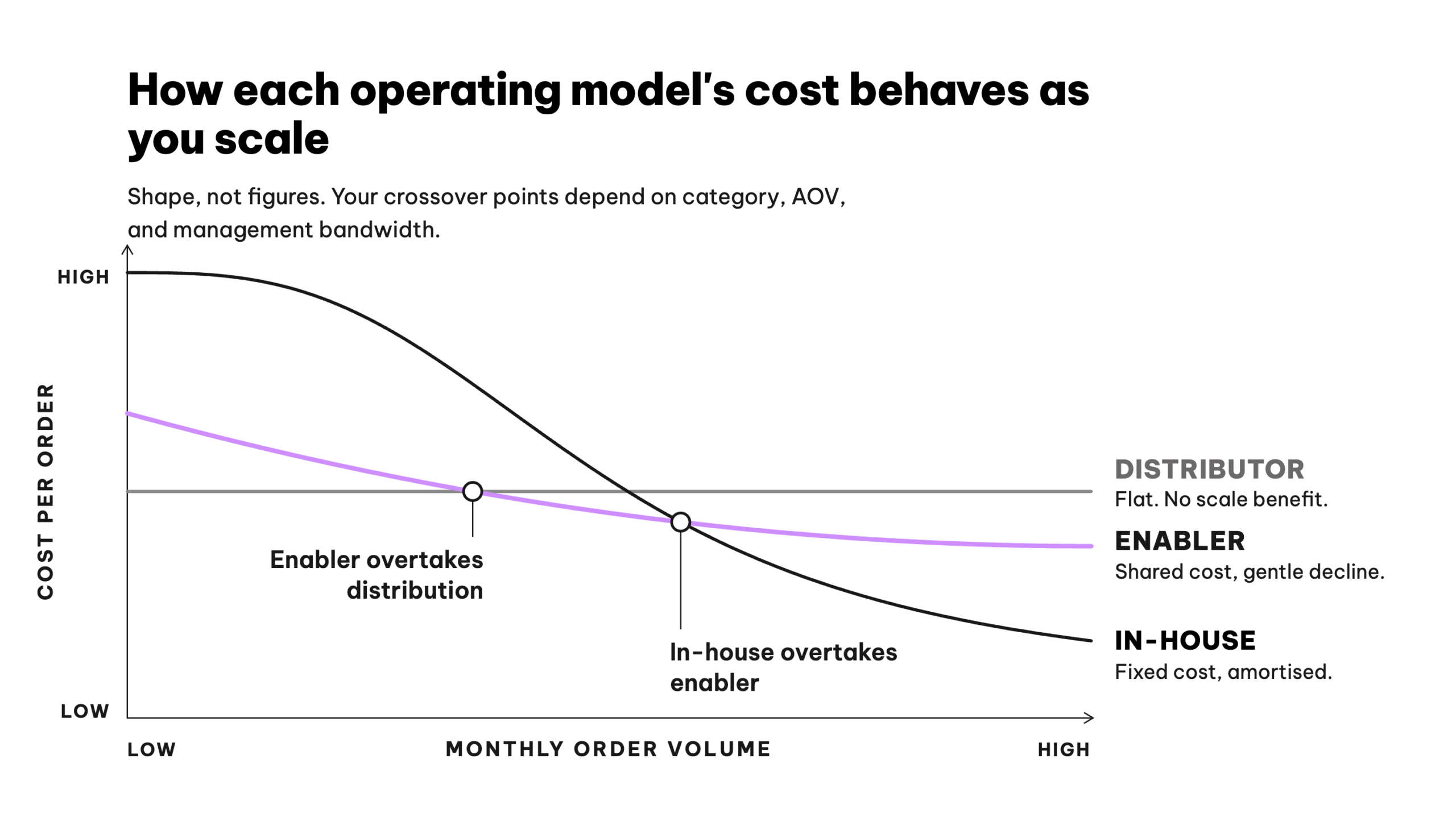
We are not publishing rate cards, ours or anyone else’s, because a number without a scope is misleading. What is worth understanding is the shape of each cost curve, because that is what determines which model wins at your volume.
In-house is high fixed, low variable. Cost per order falls steadily as volume climbs. It is punishing below the threshold and unbeatable above it. The curve only works in your favour if the volume actually arrives.
Distribution looks free and is not. There is no fixed cost, but the cost is embedded in the margin you hand over at the point of sale. It stays flat as a percentage forever and never improves with scale. You pay the same rate on your ten millionth peso as your first.
Enabler models sit between the two. Low fixed cost with a variable component. How it scales depends on the structure: a commission scales directly with you, a retainer gets cheaper per peso as you grow, and a buy discount behaves much like distribution except you retain price and brand control.
The crossover point is what matters, and there is no universal answer. It moves with your category, your average order value, your return rate, and how much management attention you can actually spare. Working out where your own crossover sits is a modelling exercise, not a rule of thumb.
FAQs
What is an e-commerce enabler?
An e-commerce enabler operates a brand’s marketplace business end to end: listings, advertising, content, live selling, customer service, and compliance. Unlike a distributor, the enabler does not take ownership of your pricing or your brand decisions. Some enablers also act as Seller of Record, holding the account and carrying the invoicing and tax obligations.
What is the difference between an e-commerce enabler and a distributor?
Ownership and incentives. A distributor buys your inventory and resells it on its own terms, earning on the spread, which rewards discounting. An enabler operates on your behalf under a contract that defines pricing policy, so your price integrity and customer data stay with you.
Do I need a Philippine entity to sell on Shopee, Lazada, or TikTok Shop?
To sell as a local seller with full campaign access, yes: a registered Philippine entity is required, whether your own or a partner acting as Seller of Record. Foreign corporations must be licensed by the SEC under the Revised Corporation Code before transacting business locally. Platform cross-border programs are an alternative with different trade-offs.
At what order volume should I hire an e-commerce enabler?
Most brands hit the wall between roughly 300 and 1,500 orders a month, when a single person can no longer handle listings, ads, content, and customer service together. The threshold moves with SKU count and average order value, and non-volume triggers such as entity status or campaign load often arrive first.
How do e-commerce enablers charge in the Philippines?
Three common structures: a commission on GMV, a fixed monthly retainer, or a buy discount where the enabler purchases stock and sells as Seller of Record. Many arrangements combine them. Each structure creates different incentives, so understand what the model rewards before comparing prices.
Can I work with an enabler and keep my existing distributor?
Often yes, and it is a common arrangement. The distributor remains the seller of record while the enabler operates the storefront under an agency structure. This depends entirely on what your existing distributor agreement says about online rights, so review that contract first.
Not sure which model fits?
The honest answer is that it depends on numbers you already have and probably have not lined up next to each other: your monthly order volume, your entity status, what your distributor agreement actually permits, and how much management bandwidth you can realistically commit.
Dynamix is an AI-powered e-commerce enabler based in Quezon City, Philippines that helps brands grow and convert on Shopee, Lazada, and TikTok Shop. We will map your current setup against all three models and tell you which one fits, including the times when the answer is that you should stay in-house.
Sources: Revised Corporation Code of the Philippines (Republic Act No. 11232), Securities and Exchange Commission, Bureau of Internal Revenue, and the official seller centres of Shopee Philippines, Lazada Philippines, and TikTok Shop Philippines.